Posted by Broken Arrow Team on Jul 20th 2026
How to Choose the Best Binoculars for Hunting, Scouting, and Outdoor Use
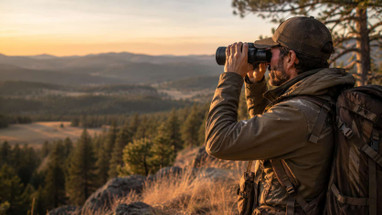
There's a moment every hunter knows. Last light is bleeding out of the sky, something moves at the far edge of the field, and you lift your glass to see what it is. What happens next tells you everything about the binoculars hanging around your neck. A good pair turns that gray shape into a clear, makeable decision. A cheap pair turns it into a guess.
That moment is why choosing the best binoculars for hunting matters more than most folks give it credit for. Too many buyers pick a pair off the wall based on the highest magnification number or the lowest price tag, only to find out the hard way that neither one tells you how the glass actually performs when the light goes flat.
Our team put this guide together to help you skip that lesson and walk away with optics that earn their place in your pack, whether you're hunting, scouting, or just glassing the back forty.
What Actually Makes a Good Pair of Hunting Binoculars
The numbers printed on the barrel are only part of the story. What separates the glass you'll love from the glass you'll replace comes down to a few things that rarely make the marketing copy.
Clarity matters more than raw power. A sharp, bright image from quality glass beats a dim, fuzzy one at higher magnification every time, especially when you're trying to pick a bedded deer out of shadow. How much light a binocular delivers to your eye is the quiet hero here, and it's worth enough that it gets its own section below.
Then there's durability. Anything you carry into the Georgia woods is going to get rained on, banged against a tree stand, and dragged through a cutover, so sealed, fogproof, rubber-armored glass isn't a luxury, it's the baseline.
How Much Magnification Do You Really Need
It's tempting to grab the highest-power glass on the shelf and figure more is always better. It isn't, and understanding why will save you from regretting a purchase on your first hunt.
Magnification is the first number in a binocular's name. An 8x pulls your subject in eight times closer, a 10x ten times. The catch is what you give up as that number climbs. The Cornell Lab of Ornithology notes that lower-magnification binoculars sit in a sweet spot, with enough power to bring detail in close while keeping a steady, wide view that makes it easier to find your animal and stay on it as it moves. Step up to 10x, and you gain reach, but the view through the glass gets narrower, and every little shake in your hands shows up more.
Neither one is better in a vacuum. It comes down to how and where you hunt. If you're glassing across a Middle Georgia cutover, a powerline, or an open field where you want to reach out and read detail on a deer at distance, that extra reach from a 10x earns its keep. A 10x42 is about as versatile as it gets for our part of the state, which is exactly why it's the configuration most hunters around here settle on.
If most of your sits are tighter, in the timber or close cover where game shows up fast and close, a lower power and its wider view can help you get on the animal quicker. Wherever you land, a steady rest beats raw power every time, so brace against a tree or a shooting rail when you can.
Why the First and Last Hour Decide Everything
Ask any deer hunter when they see the most movement, and they'll tell you the same thing: the gray light right after the alarm goes off and the last few minutes before legal light runs out. That's prime time, and it's also the hardest test your optics will ever face.
This is where objective lens size and glass quality stop being spec-sheet trivia and start being the difference between filling a tag and going home. A larger objective lens, the 42mm or 50mm front glass, pulls in more light than a compact lens can.
Pair that with fully multi-coated optics, and you get an image that stays bright and usable when the sun is already behind the trees. Cheap binoculars fall apart in exactly these conditions, going dim and muddy right when you need them sharpest. Quality glass keeps working through that last critical window, and for a Georgia hunter watching a food plot or a field edge at dusk, that window is often the whole hunt.
Features Worth Paying For and What to Skip
Once you start comparing models, the feature lists can blur together, and that's where a lot of money gets spent in the wrong places. The trick is knowing which line items actually change your day in the field.
The features covered above, the glass quality, the light-gathering, and the weatherproof build, are the ones worth opening your wallet for, because you feel them on every hunt. The traps are easier to spot once you know to look. A long list of tech extras can pad the price without sharpening a single thing you'll ever see through the lens. Built-in rangefinders and digital readouts sound clever but add weight, drain batteries, and rarely survive a hard season of real use.
And a respected name on the barrel only means something when the optical performance backs it up, so judge the view, not the logo. Spend on what you'll notice at first light, and let the rest go.
Matching Your Binoculars to How You Hunt
The right pair depends on the kind of hunting you do most, and a little honesty about how you actually spend your season points you straight at the answer.
If you hunt from a stand or sit tight cover, you want something light around your neck and quick to the eye, with the low-light strength to make the most of those first and last minutes when a deer steps out close. Spot-and-stalk hunters working open country lean the other way, trading a little weight for the magnification and long-distance clarity it takes to read an animal a few hundred yards off before committing to the stalk.
If you cover ground on public land, durability and a compact, easy-carry build matter more than anything, because the best glass in the world does you no good if it's too bulky to keep on you mile after mile. And out on wide fields and cutovers where shots and looks stretch long, more power earns its place, as long as you pair it with a rest or a tripod so that magnification works for you instead of against you.
Most Middle Georgia hunters split their time between field edges, food plots, and stretches of timber, which is why a versatile 10x42 covers so many of those situations well. If your hunting leans hard one direction, let that guide you, but a solid all-rounder rarely steers you wrong.
Mistakes That Cost Hunters Money
A few buying missteps recur again and again, and each is avoidable. Shopping on price alone usually means replacing the glass in a season or two. Chasing the highest magnification leaves a lot of folks with a shaky, narrow view they can't hold steady. Ignoring weight feels fine in the store and miserable after a full day in the field. And skipping over low-light performance is the costliest oversight of all, for the reasons we covered above.
The good news is that knowing what to look for, which you now do, makes every one of these easy to sidestep.
Where to Find the Best Hunting Binoculars in Middle Georgia
Broken Arrow Outfitters has been Middle Georgia's go-to outfitter from our home base in Perry, and our team knows the difference between glass that performs and glass that just looks good on a shelf. We carry trusted names, and we're happy to talk through magnification, objective size, and low-light performance so you leave with a pair matched to how and where you hunt.
Take a look at our selection of hunting binoculars, or if your glassing runs beyond the deer woods, browse our binoculars for all-around outdoor use. You can also round out your kit from our full lineup of hunting gear and field essentials.
Ready to See the Difference Good Glass Makes
The right binoculars turn that last-light guess into a confident decision, and the wrong ones cost you the chance. When you're ready to put quality optics in your hands, our team is here to help you choose a pair that fits your hunt and your budget. Browse our binoculars built for real hunting conditions online, or stop by the shop in Perry and look through a few in person before you decide.