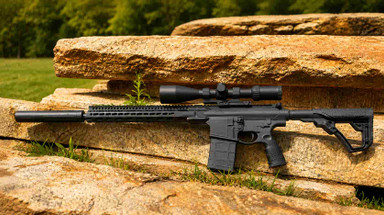
Posted by Broken Arrow Team on Aug 26th 2026
How to Choose the Right Rifle Scope for Deer Hunting and Target Shooting
Most hunters don't miss because of skill; they miss because their scope setup doesn't match their hunting conditions. Distance, positioning, and preparation are documented factors in whether a shot connects: a peer-reviewed study of 2,281 field shots by 102 licensed deer stalkers in the UK found that hit probability dropped specifically when the target was distant and when the shooter lacked regular practice.
Learning how to choose a rifle scope means addressing those exact variables before you ever pull the trigger, not just picking whatever has the highest magnification number on the box.
The confusion is real. Magnification ranges, reticle types, low-light performance- all of it gets thrown at buyers at once, and most walk away more overwhelmed than informed.
Broken Arrow Outfitters stocks scopes spanning that entire range, from compact entry-level glass to long-range precision optics, for exactly this reason. This guide helps you choose the right scope based on how you actually hunt, not just specs on a shelf.
Why Does the Wrong Rifle Scope Cost You Shots, Even at Close Range?
Over-magnification is one of the most common and least understood mistakes. A scope zoomed in too far narrows your field of view, which makes it harder to acquire a moving target quickly, even at ranges where you'd expect an easy shot.
Poor low-light performance compounds the problem during dawn and dusk, exactly when most deer movement happens. Cheap glass distorts clarity just enough to throw off shot placement, and a reticle that's more complicated than you actually need slows down decision-making at the moment it matters most.
This isn't about chasing better gear for its own sake. It's about not missing opportunities you'd otherwise have taken cleanly.
The 3 Decisions That Actually Matter When Choosing a Rifle Scope
Instead of getting buried in specs, three questions do most of the work.
How far are you actually shooting? Under 100 yards calls for low magnification. 100 to 300 yards calls for moderate magnification. Long-range shooting needs higher zoom paired with real stability.
When do you hunt most? Early morning and late evening hunts should prioritize light transmission above almost everything else. Daytime hunting is far less dependent on premium glass.
How mobile is your hunting style? Mobile hunters benefit from lightweight scopes that don't add fatigue over a long stalk. Stationary hunters, blind or stand setups, can comfortably handle heavier optics.
Understanding Magnification Without Overcomplicating It
A spec like "3-9x40" looks like a code, but it's simpler than it seems. The first two numbers are the magnification range, 3x at the low end up to 9x at the high end. The 40 is the objective lens diameter in millimeters, which affects how much light the scope gathers.
For deer hunting specifically, 3-9x is the most versatile range available, and it's the range most experienced hunters land on regardless of brand or price point. Higher magnification becomes a disadvantage the moment it costs you field of view on a close, fast-moving shot. Balancing zoom against real-world usability matters more than chasing the biggest number on the label.
Low-Light Performance: The Feature That Actually Matters in Hunting
Most deer movement happens at dawn and dusk, which means a scope's low-light performance often matters more than its maximum magnification. Objective lens size is part of the equation; a larger lens gathers more available light, but lens coatings and overall glass quality determine how much of that light actually reaches your eye with clarity.
This is where cheaper scopes tend to fail at exactly the wrong moment, a legal shooting window closing fast in fading light. Broken Arrow Outfitters specifically stocks brands like Trijicon and Swarovski Optik for hunters who prioritize this, since a scope that only performs in bright daylight misses the exact window most deer are actually moving.
Reticle Types Explained Simply
A Duplex reticle is the standard choice for most hunters, simple, fast, and easy to use under pressure. A BDC reticle helps at longer distances but requires understanding your specific bullet's drop, which takes some homework before the season starts. An illuminated reticle helps in genuinely low light, but it isn't necessary for every hunter or every hunt.
The mistake most buyers make is choosing a more complex reticle than they'll actually use consistently.
Scope Weight, Size, and Balance Matter More Than You Think
A heavy scope changes how a rifle carries and swings, which affects both mobility and fatigue over a long day in the field. For public land hunters covering serious ground on foot, a lightweight setup isn't a luxury; it's what keeps the rifle comfortable to carry for hours, not just comfortable to hold at the counter.
Since Broken Arrow Outfitters operates as a physical, in-store dealer as well as online, you can actually pick up and compare the weight of two scopes side by side before deciding, something no spec sheet or online-only retailer can offer.
What Mistakes Are Most Hunters Making When Buying a Rifle Scope?
A few patterns show up again and again. Choosing far more magnification than the hunting style actually calls for. Buying based on brand name alone rather than matching the scope to the rifle and the hunt.
Overlooking mounting quality, a scope is only as accurate as the mount holding it in place. Failing to match the scope to the actual hunting style, mobile versus stationary. And paying for features that sound impressive but never get used in the field.
A precise scope on a loose or poorly torqued mount will never hold zero, no matter how good the glass is. That's one detail worth double-checking with in-store staff before you leave, not something to assume is handled.
Where to Find the Right Rifle Scope for Your Setup
Broken Arrow Outfitters is Middle Georgia's own outfitter, based in Perry, GA, carrying rifle scopes that span entry-level glass through long-range precision optics, so you can match a scope to your actual hunting conditions instead of guessing based on price alone.
Ready to Stop Guessing on Your Next Scope?
Don't let the wrong scope cost you your next shot. Shop rifle scopes built for clarity, durability, and real hunting conditions, no guesswork needed.